Hi, I'm

Weiliang Will Zeng, Ph.D.

Sr Staff System Engineer/Manager, Qualcomm AI Research

I am working on making generative AI efficient enough to run on real devices – LLM/VLM/LVM model quantization, MoE inference, code generation with efficient test-time-scaling, ML compiler optimization, and neural scheduling – so state-of-the-art AI can run faster, smaller, and cheaper at the edge.

Weiliang Will Zeng, Ph.D. profile image

About Me

Weiliang Will Zeng, Ph.D. profile picture

I’m with Qualcomm AI Research, San Diego, CA, where I’m now a Sr Staff System Engineer/Manager. I received my Ph.D. degree from the Department of Electronic Engineering, Tsinghua University, Beijing, China, in 2012 and my B.S. degree in electronic engineering from the University of Electronic Science and Technology of China (UESTC), Chengdu, China, in 2007, both with the highest honor. I was a Research Scholar (2009-2011) and a Post-Doctoral Fellow (2013-2014) at Missouri University of Science and Technology (formerly University of Missouri, Rolla, MO).

I was honored to receive the prestigious Qualcomm IP Achievement Award (AI domain) in 2025, multiple QualStar Awards from Qualcomm, the Excellent Doctoral Student Scholarship from the Ministry of Education of China, the Distinguished Honor Graduate award from the Beijing Municipal Commission of Education, and the First-Class Scholarship for graduate students from Tsinghua University. I’m a frequent author and reviewer for top-tier journals/conferences, TPC Co-chair for IEEE Globecom'17, and TPC member for various flagship conferences.

Research Interests:
  • Generative AI (LLM/VLM/LVM)
  • Model Quantization
  • ML Compiler Optimization
  • Optimization Algorithms
  • Information Theory
  • Signal Processing

Experience

Sr Staff System Engineer/Manager - Qualcomm AI Research
Dec. 2014 - present
  • Generative AI & LLM/VLM/LVM Efficiency: research and engineering to make large language, vision-language, and vision models efficient enough to run at the edge
    • Co-authored “How Efficient is LLM-Generated Code? A Rigorous & High-Standard Benchmark” (ICLR 2025)
    • Multiplication-only matrix inversion approximation for quantized Gated DeltaNet models (ICLR 2026 Workshop)
    • Multiple patents on ML-based code generation systems and efficient inference for MoE (Mixture-of-Experts) models
  • Model Quantization: quantization and mixed-precision techniques for diffusion and language models
    • FineAMP: optimization-based automatic mixed-precision quantization for efficient diffusion model inference (OPT 2025, NeurIPS workshop)
  • ML Compiler & Scheduling Optimization: patents and publications on scheduling and optimizing ML compute graphs
    • Neural DAG scheduling via one-shot priority sampling (ICLR 2023) and neural topological ordering (NeurIPS 2022)
    • Multiple patents on distributed ML compiler optimization, node symmetry optimization, and scheduling in sequence space
  • Earlier at Qualcomm
    • 5G+AI: Invented 5G+AI algorithms that were successfully commercialized in Qualcomm modem product, as part of the company’s first ML-for-wireless project
    • Contributed to Qualcomm’s CoMP Spectrum Sharing technology, showcased at MWC'18 and MWC'19
Feb. 2013 - Dec. 2014
  • Adviser: Prof. Chengshan Xiao
  • Research Topic: Transceiver design for multiple antennas, MIMO-OFDM, 4G LTE, cognitive radio, and energy harvesting networks
Research Scholar
Aug. 2009 - Aug. 2011
  • Adviser: Prof. Chengshan Xiao
  • Research Topic: Adaptive transmission for practical systems with finite-alphabet inputs; capacity analysis; precoding for MIMO systems; practical design for MIMO-OFDM systems
  • Achievement: Invented algorithms provide significant performance gain for practical MIMO systems and are successfully implemented for technical field trials.
Research Assistant - Tsinghua University
Sep. 2007 - Dec. 2012
  • Adviser: Prof. Jianhua Lu
  • Research Topic: Precoded modulation for wideband wireless communications; precoder design for cognitive radio and relay networks with finite-alphabet inputs
  • Published 6 IEEE Journal papers and 10 IEEE Conference papers during Ph.D. study; held 4 patents

Education

2007 - 2012
Ph.D., Electronic Engineering
Tsinghua University
GPA: 88/100
  • Adviser: Prof. Jianhua Lu
  • Graduated with the highest honor
  • Thesis: Precoded Modulation for Wideband Wireless Communications
  • Published 6 IEEE Journal papers and 10 IEEE Conference papers; held 4 patents
2003 - 2007
B.S., Electronic Engineering
University of Electronic Science and Technology of China (UESTC)
GPA: 3.8/4.0
  • Graduated with the highest honor
  • Ranking: top 0.2%; granted admission to Tsinghua University for Ph.D. study without national standardized test
  • Thesis: Algorithm design, performance analysis, and hardware implementation for phase lock loop systems

Software

Approximation of Mutual Information (MI)
MATLAB C++ (mex)
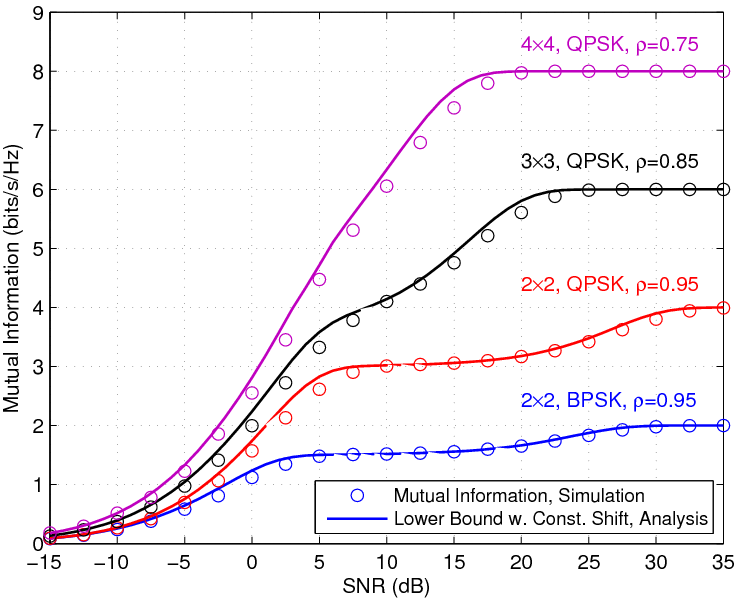
Approximation of Mutual Information (MI)

Calculating the MI for MIMO channels with finite-alphabet inputs can be difficult – the embedded multiple integrals are hard to evaluate accurately, and Monte-Carlo estimation is slow. This code derives a lower bound with no integrals and low computational effort, approximating the MI (with a constant shift) across settings.

Details in: W. Zeng, C. Xiao, and J. Lu, “A Low-Complexity Design of Linear Precoding for MIMO Channels with Finite-Alphabet Inputs,” IEEE Wireless Commun. Letters, vol. 1, no. 1, pp. 38-41, Feb. 2012.

Approximation of Average Mutual Information (AMI)
MATLAB C++ (mex)
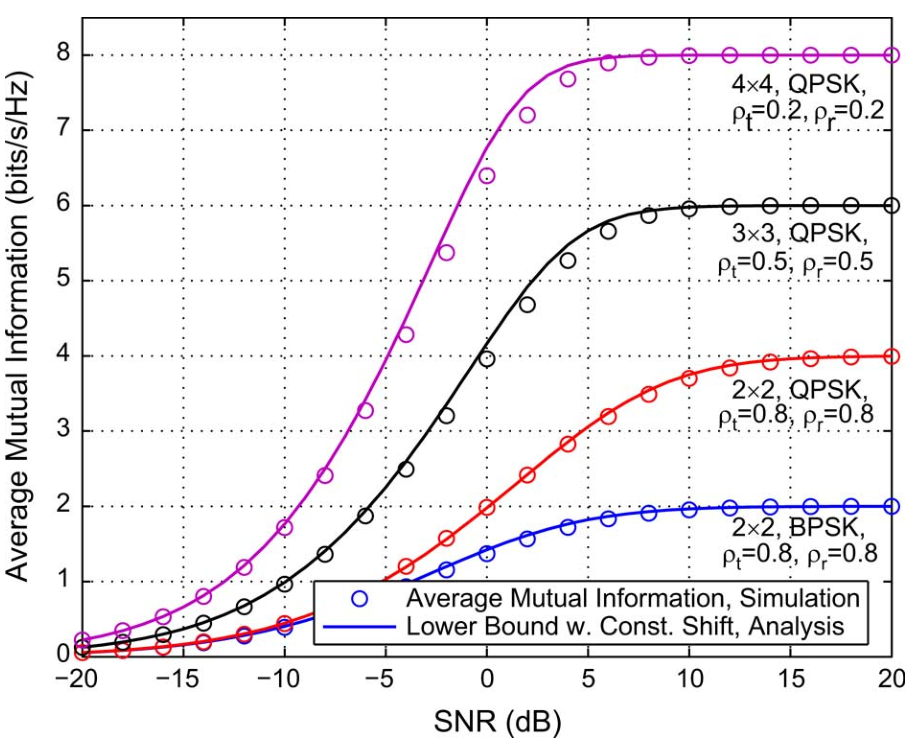
Approximation of Average Mutual Information (AMI)

Calculating the AMI under statistical CSI is even harder than MI, since it also averages over the fading channel. This code develops the lower bound and approximation for doubly-correlated MIMO channels.

Details in: W. Zeng, C. Xiao, M. Wang, and J. Lu, “Linear Precoding for Finite-Alphabet Inputs Over MIMO Fading Channels With Statistical CSI,” IEEE Trans. Signal Process., vol. 60, no. 6, pp. 3134-3148, Jun. 2012.

Contact

Feel free to reach out by email, or scan the QR code below to add my contact info to your phone.

QR code